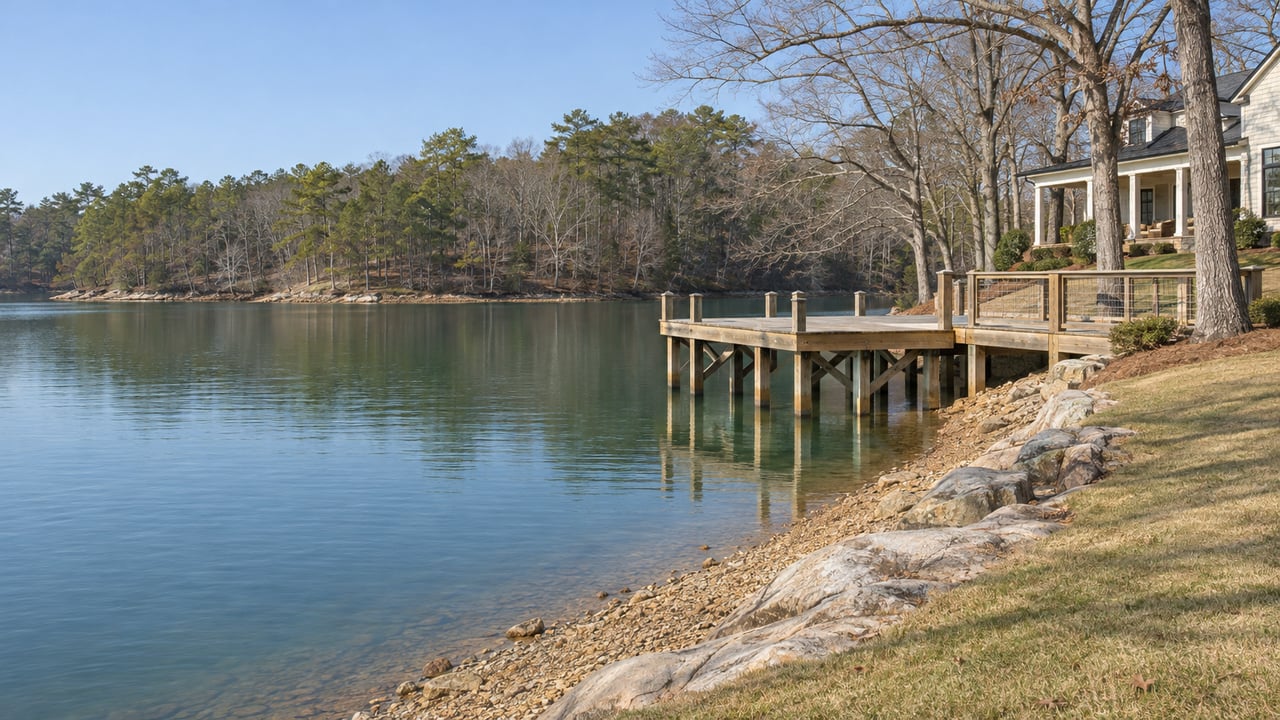
Most lake house shopping happens in summer, when the water is up and every dock looks the same. On Lake Martin, winter is when you can learn the most about a waterfront lot. Alabama Power lowers the lake about seven feet each fall. The lower water shows the depth at the end of the dock, the rocks where children would swim, and the seawall under the summer waterline. Those months are also when the fewest buyers are out looking, and this fall's sales figures describe a market close to balance. A buyer who tours a house this winter sees more of the property, with less competition, than a buyer who waits for June.
Seven feet of shoreline in plain view
Alabama Power manages Lake Martin to a summer pool of 491 feet above sea level and a winter pool of 484 feet. In the company's 2025 notice, it expected to reach the winter level by the third week of November. The Alabama Power Shorelines gauge for Lake Martin read just under 484.83 feet in mid-November 2026. That puts the lake at about its winter level as Thanksgiving week arrives.
Under the usual schedule, refill starts around February 28, and the lake is expected back at 491 feet around April 28, depending on conditions. So the exposed shoreline is there to see from about Thanksgiving to the end of February. Those dates set the window for this kind of shopping.
What the dock shows at 484 feet
In summer, a buyer has to take the seller's word, or a weighted line, for the depth at the end of the dock. In winter, the lakebed is visible. With the water down, you can see the depth at the end of the dock for yourself, along with any large rocks where children would swim. Docks, floating docks and personal watercraft floats are fully exposed in winter, so any repairs they need are plain to see, and that is useful information to bring to a negotiation.
For a buyer with a boat, the useful question is how the slip will work at summer pool, since that is when the boat will be in the water most. Seven feet of drop is the gap between the bottom you can see in January and the water you will have in July. If you can stand on the dock in winter and see the bottom near the end, you can picture the summer depth with some confidence. A floating dock resting at an angle on mud, or a float pulled off its frame, is a repair to plan and price before closing rather than after the first warm weekend.
The band between the two waterlines
Shorelines on Lake Martin drop at different rates, and the drawdown makes the difference easy to see. Lake Martin Riprap describes how a seven-foot drop exposes a wide strip on a gently sloping shoreline and a narrow one on a steep bank. The two kinds of lot feel different in summer as well. A gentle slope usually means a longer walk out to deep water. A steep bank usually puts depth closer to shore, with more grade between the house and the water.
The same contractor names what low water can show along a seawall: scour at the base of the wall, undercutting, and backfill washed out from behind it. All of that is underwater in summer. Given my background in building science, this is the part of a waterfront house I would want a buyer to see firsthand. A seawall holds back the slope the house stands on, and its condition matters to the property as much as the roof does.
Access is the other point from that contractor. A cove can be too shallow in winter for a loaded barge to reach a lot. If a winter tour turns up dock or seawall repairs, ask how a contractor would get materials to that lot, and in which season. A shallow cove is worth knowing about for repair planning, separate from what it means for boating.
Why the fall numbers make winter a working season
Lake Martin is a seasonal market, with about 80 percent of sales typically closing between March and October. Inventory usually starts building in February, peaks in August and tapers off after that. From November through March, buyers face less competition and fewer multiple offers. The 2026 figures match that pattern.
The Alabama Center for Real Estate publishes a waterfront-only report with the Lake Martin Area Association of Realtors. In its September 2026 report, active listings fell from 233 in August to 191 in September. That is the end-of-summer taper on schedule. September's 191 listings were still up 15.1 percent from September 2025, so this winter's buyers have more homes to choose from than last winter's did.
Supply stood at 5.5 months in September 2026. ACRE treats about six months of supply as the point where buyers and sellers have roughly equal bargaining power. Homes sold in September averaged 95 days on the market, 25.8 percent faster than in September 2025. Year-to-date sales through September reached 255, up 12.8 percent from the same period in 2025.
The overall picture is steady demand and inventory close to balance, heading into the slow season. A winter buyer gets that balance with fewer competing offers than in summer, which leaves time to study a lot closely. If a dock float needs rebuilding or a seawall shows scour at its base, that is a specific, visible item the buyer can raise when making an offer.
Why the median is a poor guide to one lot
The monthly median price for Lake Martin waterfront has moved a lot this year. In ACRE's July 2026 report it was $799,500, down 36.4 percent from July 2025. ACRE noted that small sample sizes can make prices volatile. The median was $1,200,000 in August and $1,100,000 in September, and the year-to-date median through September 2026 was $1,177,580, up 7.1 percent from the same period in 2025.
A $400,500 jump in the median from July to August, on 36 and 45 sales, mostly reflects which houses happened to close. It doesn't tell you what any one lot is worth. A specific lot's value depends on things a monthly report can't measure: water depth at the dock, how steep the bank is, the condition of the wall and the float. Those are what a winter tour lets you see.
Planning a winter visit
Because the window runs from late November to the end of February, a single trip can do a lot of work. Walk the shoreline and stand at the end of the dock. Photograph the seawall from below its summer waterline. Note whether the cove looks too shallow for a barge. Compare two or three lots on different slopes on the same day, and the differences will be obvious. For background on the lake itself, our Lake Martin overview and the Lake Martin neighborhood page are good places to start.
Buyers who trailer a boat now have more room at Kowaliga. The Western Star reported that phase one of the Kowaliga Public Boat Ramp renovation added a new launch slab, 86 truck-and-trailer spaces, seven car spaces and turn lanes. If you buy this winter, the house you saw at 484 feet should hold no surprises when the lake is back at 491 feet in late April, and you'll have the summer on the water ahead.
If you're thinking about a Lake Martin house this winter, I'd be glad to talk through what you want from it and how the low lake can help you evaluate lots. I'll then introduce you to a trusted Lake Martin agent through my Sotheby's International Realty connections, someone who knows these coves and shorelines well. Laura Silsbee works from Mountain Brook with buyers who want a lake house that fits the way they plan to use it. Let's Connect.